
Shuttering Plywood
The name the Gulf, UK and South Asian trade uses for the film-faced panel that holds wet concrete. Pressed at 2440 × 1220 mm in 12, 15, 18 and 20 mm, FOB Xiamen.
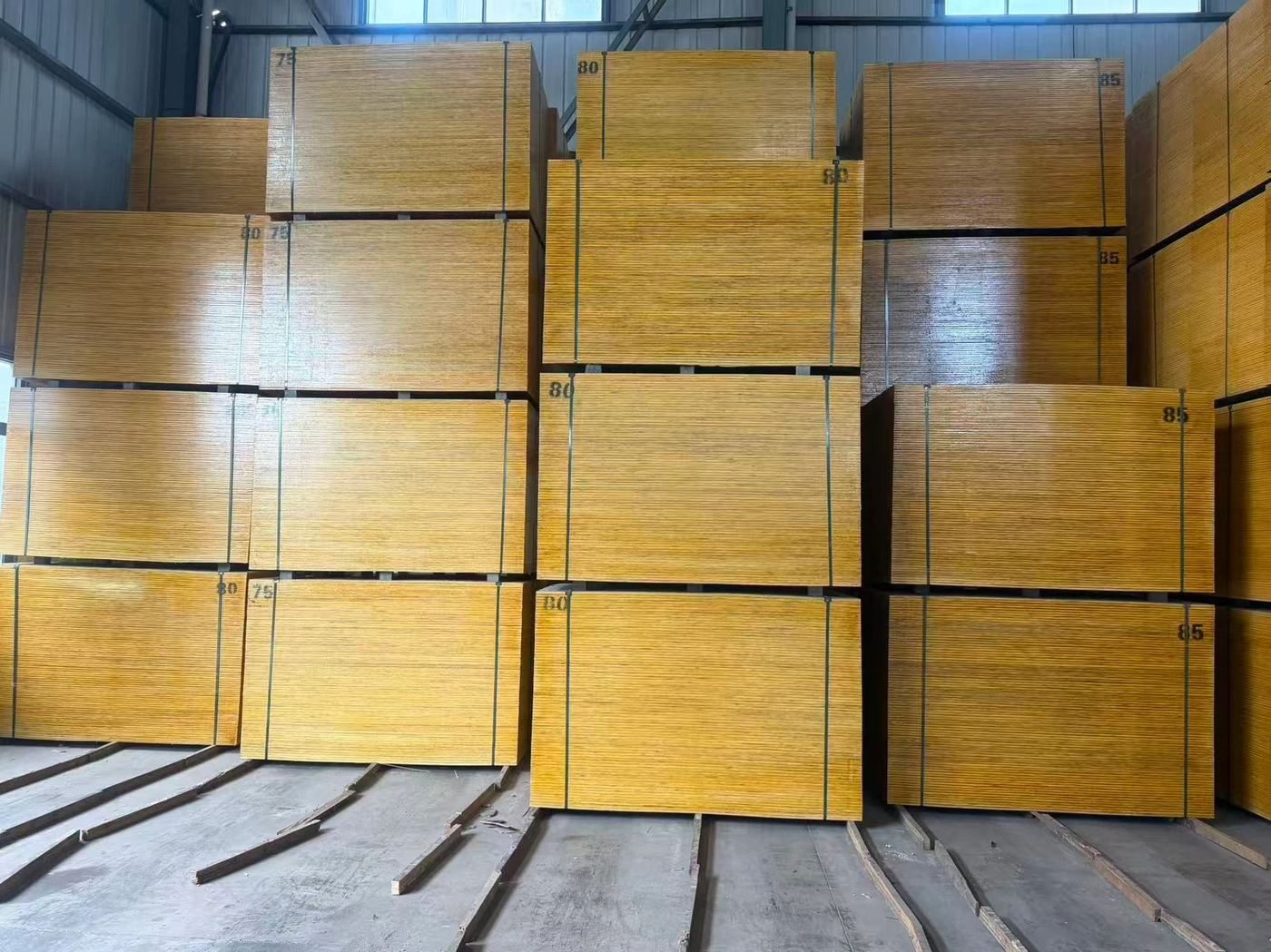


What buyers in this trade mean by it
Shuttering plywood, formwork plywood and film faced plywood are three names for one product. The word changes with the market: shuttering in Dubai, Doha and Mumbai, formwork on European specifications, film faced on price lists. What the buyer is ordering is a plywood panel with a resin-impregnated film face, strong enough to hold fresh concrete and smooth enough to leave a face that does not need patching.
| Size | 2440 × 1220 mm (8 × 4 ft) |
| Thickness | 12 / 15 / 18 / 20 mm |
| Face | Black phenolic film, 60 g/m², double-sided |
| Finished film | ≈ 180–185 g/m² after pressing |
| Core | Combi core: eucalyptus, pine, fir |
| Glue | WBP phenolic, boil-proof 72 h |
| Reuse | 8–12 cycles, normal site conditions |
| Loading | 18 mm: 930–960 panels per 40HQ |
| Port | FOB Xiamen |
18 mm is the working size
In Gulf shuttering work, 18 mm is the default: it carries normal column, beam and wall pressure without the extra bracing that a 12 mm panel needs, and it survives being stripped and re-set dozens of times on one site. We load 930 to 960 panels in a 40HQ at 18 mm, limited by the 28.5 t payload rather than by floor space.
12 and 15 mm are still sold in volume, but for slabs, low walls and site-cut infill where bracing sits close behind the panel. A buyer who has not decided the thickness usually ends up at 18 mm.
Panels rarely fail in the middle
The face delaminates at the edge before the panel breaks in the middle. Water gets into the exposed veneer at a cut edge or a tie hole, the film lifts at that point, and the panel starts to scab. That is why every panel leaves the plant with waterproof edge paint, and why we tell buyers to re-paint edges after site cuts.
Second cause is the face being sanded to remove set concrete: sanding removes the film that gives the cycle count. Washing and a wooden scraper cost less than a lost panel.
Shuttering is the trade word, formwork is the engineering word
A shuttering buyer asks: how many panels in the container, what is the price per panel, can you ship mixed thicknesses. A formwork buyer asks: what is the measured bending strength, what is the deflection under a known load, does the panel meet the specification on the drawing. Both end up ordering the same panel from us, but they need different pages — the engineering version, with the measured values from the CMA report, is on formwork plywood.
The specification itself is on this page, the strength figures are on the other, and the loading plan is on packing and loading.
Three that come up every week
Is shuttering plywood the same as film faced plywood?
Yes. Shuttering is the trade name used in the Gulf, the UK and South Asia; film faced is the name used on price lists. The product is the same: a plywood panel with a phenolic film face, used to hold concrete.
Can you ship two thicknesses in one container?
Yes, mixed thicknesses are quoted per order. The container still has to stay inside the 28.5 t payload, so the mix is calculated rather than guessed.
Do you have FSC or CE?
Not yet. We hold CMA test reports and an enterprise standard, and the quality page says so plainly. If your tender requires FSC or CE, we tell you before deposit rather than after.